





















Understanding bookkeeping package pricing is not always straightforward.

Some providers advertise low monthly prices, while others prepare a customized quote after reviewing the company’s transaction volume, accounts, reporting requirements, and financial systems. Two businesses with similar revenue can receive very different bookkeeping proposals because their operational complexity may be completely different.
A professional services firm with one bank account and a limited number of monthly invoices may require relatively straightforward support. An e-commerce, manufacturing, construction, or multi-entity company may need payment-platform reconciliation, inventory accounting, accounts payable workflows, payroll entries, departmental reporting, and several system integrations.
For that reason, growing companies should not evaluate bookkeeping services only by the lowest advertised price. They should evaluate what is included, how the scope is calculated, how quickly the books are closed, and whether the provider can support the company as its financial operations become more complex.
This guide explains how bookkeeping package pricing works, which factors influence your quote, what should be included in a professional package, and how to choose the right level of support.
Table of Contents
What Is Included in a Bookkeeping Package?
A bookkeeping package is a defined group of recurring financial-recording and reporting services delivered for a monthly, quarterly, hourly, or customized fee.
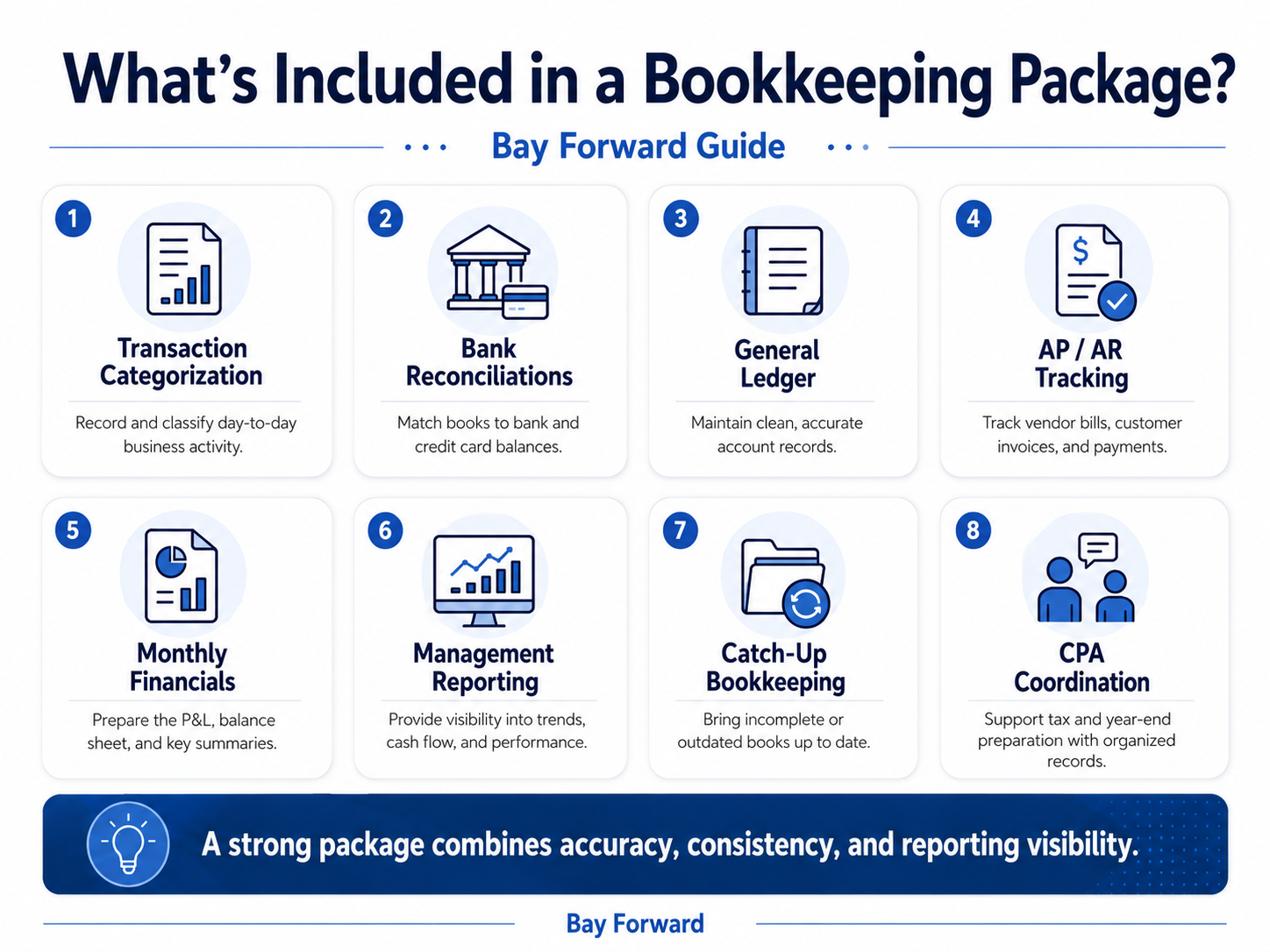
The exact scope varies between providers, but a standard bookkeeping package may include:
- Recording and categorizing business transactions
- Reconciling bank and credit card accounts
- Maintaining the general ledger
- Recording customer payments
- Recording vendor bills and expenses
- Managing accounts payable and accounts receivable data
- Reviewing uncategorized or unusual transactions
- Preparing monthly financial statements
- Maintaining supporting financial documentation
- Coordinating with the company’s accountant or tax advisor
- Providing periodic financial review meetings
The Internal Revenue Service states that a business recordkeeping system should clearly show income and expenses and should include summaries of transactions supported by documents such as invoices, receipts, paid bills, deposit records, and canceled checks.
A bookkeeping package should therefore provide more than simple data entry. It should establish an organized, repeatable process for maintaining accurate financial records and producing information management can use.
How Does Bookkeeping Package Pricing Work?
Bookkeeping companies typically use one or a combination of the following pricing models.
Fixed Monthly Package
A fixed monthly package charges a recurring fee for an agreed scope of work.
This model gives the business greater cost predictability and works well when transaction volume and monthly requirements remain reasonably consistent.
The agreement should clearly define:
- Included accounts
- Approximate transaction volume
- Frequency of reconciliations
- Reporting deliverables
- Communication expectations
- Software responsibilities
- Out-of-scope work
- Conditions that may trigger a pricing review
A fixed fee does not necessarily mean the price will remain unchanged regardless of growth. If the number of entities, accounts, transactions, employees, or integrations increases significantly, the package may need to be reassessed.
Hourly Bookkeeping
Hourly pricing charges for the actual time spent performing bookkeeping work.
It may be suitable for:
- One-time bookkeeping cleanup
- Short-term support
- System setup
- Historical transaction review
- Irregular bookkeeping requirements
- Projects with an uncertain initial scope
The disadvantage is that the total monthly cost may be difficult to predict. Hourly pricing can also make it harder to compare providers because differences in process efficiency, technology, and experience affect how many hours are required.
Transaction-Based Pricing
Some providers calculate fees based on the number of monthly transactions, invoices, bills, accounts, or reconciliations.
This approach creates a measurable pricing basis, but transaction count alone does not reflect the complete workload.
For example, 500 clean transactions automatically imported from one bank account may require less work than 150 transactions spread across multiple entities, currencies, payment gateways, and poorly maintained records.
Customized Package Pricing
Customized bookkeeping package pricing is based on the company’s actual financial environment.
The provider reviews the company’s accounts, systems, reporting requirements, transaction activity, current bookkeeping condition, and internal processes before preparing a proposal.
This model is particularly appropriate for growing businesses because it allows the package to reflect operational complexity rather than forcing every client into the same service tier.
Bay Forward uses a consultation-based approach to assess requirements and prepare customized pricing. Its bookkeeping scope can include transaction entries, bank and credit card reconciliations, multi-channel sales reconciliation, accounts payable and receivable management, financial statement preparation, payroll processing, cash-flow management, budgeting, and management reporting.
What Factors Affect Bookkeeping Package Pricing?
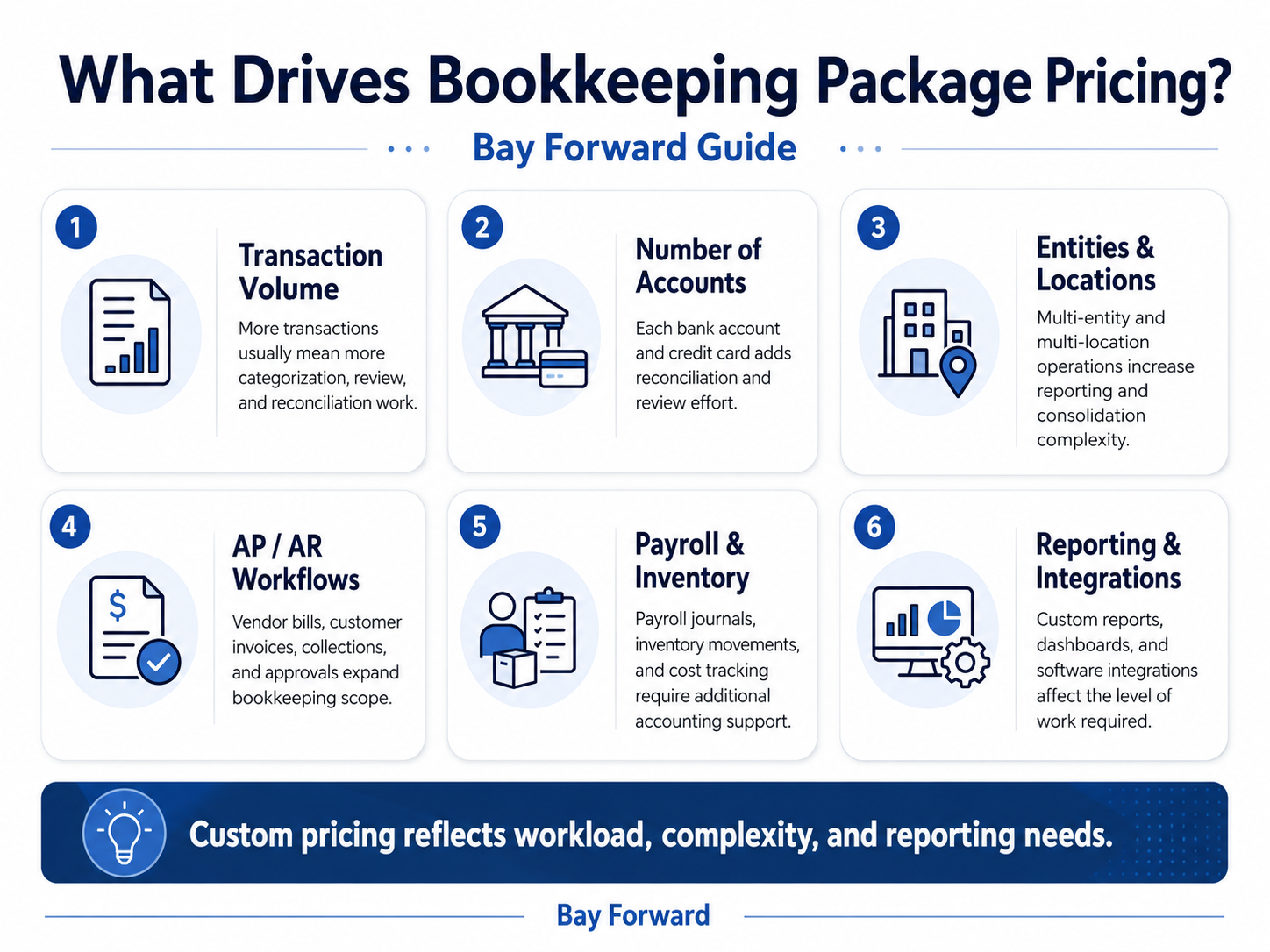
Bookkeeping pricing is usually influenced by workload, complexity, service frequency, and the professional level required.
The following factors have the greatest impact.
1. Monthly Transaction Volume
Transaction volume includes money entering or leaving the business through:
- Bank accounts
- Credit cards
- Customer invoices
- Vendor bills
- Expense platforms
- Payment processors
- E-commerce channels
- Payroll systems
- Loan accounts
- Intercompany transactions
More transactions generally require more categorization, review, reconciliation, and exception handling.
However, volume should never be evaluated in isolation. Transaction quality and system structure are equally important.
2. Number of Bank and Credit Card Accounts
Each financial account must normally be reconciled against the accounting records.
A company with one operating account has a different workload from a business with multiple bank accounts, credit cards, reserve accounts, merchant accounts, loan accounts, and foreign-currency accounts.
Inactive or rarely used accounts may also create work if they remain open and must be reviewed every month.
3. Number of Business Entities
Multi-entity bookkeeping is more complex because each legal entity may require separate:
- General ledgers
- Bank accounts
- Financial statements
- Charts of accounts
- Reconciliations
- Reporting packages
- Intercompany entries
Companies with subsidiaries, holding companies, franchises, or operations in several locations may also need consolidated financial reporting.
The provider must determine whether the package covers one entity, several entities, or a consolidated group.
4. Accounts Payable Requirements
Basic bookkeeping may record vendor expenses after payment.
A broader accounts payable package may include:
- Vendor bill entry
- Invoice-document management
- Approval workflows
- Payment scheduling
- Vendor statement reconciliation
- Aging reports
- Duplicate invoice checks
- Payment-platform coordination
The more responsibility the provider assumes before and after payment, the more extensive the package becomes.
5. Accounts Receivable Requirements
Accounts receivable support may range from recording customer payments to managing the complete invoicing and collection process.
A more advanced package may involve:
- Invoice creation
- Payment application
- Customer account reconciliation
- Aging analysis
- Collection follow-ups
- Credit memo processing
- Refund tracking
- Revenue reconciliation
Businesses with recurring subscriptions, project billing, milestone invoices, retainers, or high customer volume generally require more specialized workflows.
6. Payroll Complexity
Bookkeeping and payroll are connected but are not always included in the same package.
Pricing may be affected by:
- Number of employees
- Number of payroll cycles
- Salaried and hourly employees
- Bonuses and commissions
- Contractor payments
- Benefit deductions
- Multiple states or locations
- Payroll journal entries
- Payroll liability reconciliation
The proposal should state whether the provider processes payroll, records payroll results, reconciles payroll accounts, or only coordinates with a separate payroll provider.
7. Inventory and Cost Accounting
Inventory-based companies usually require more complex bookkeeping than service businesses.
The provider may need to reconcile:
- Inventory purchases
- Warehouse balances
- Sales channels
- Returns and refunds
- Shipping expenses
- Cost of goods sold
- Inventory adjustments
- Merchant payouts
- Multiple warehouses
- Work in progress
Manufacturing, wholesale, retail, and e-commerce companies should confirm that the provider understands inventory accounting and the systems used to manage stock.
8. Accounting Software and Integrations
Bookkeeping can become more efficient when banks, payment platforms, payroll systems, e-commerce applications, and operational systems are properly connected.
Pricing may increase when the provider must work with:
- Multiple disconnected applications
- Manual spreadsheets
- Custom integrations
- Incomplete bank feeds
- Unsupported legacy software
- Duplicate charts of accounts
- Inconsistent system configurations
The software subscription itself may or may not be included in the bookkeeping package. This should be clarified before signing the agreement.
Bay Forward works with accounting and ERP technologies and identifies itself as both a Certified Odoo Partner and a QuickBooks ProAdvisor. Its approach combines accounting expertise with automated transaction categorization, reconciliation, and reporting processes.
9. Reporting Requirements
A basic bookkeeping package may provide a monthly profit and loss statement and balance sheet.
Growing companies may require:
- Cash-flow statements
- Departmental reporting
- Location-level reporting
- Budget-versus-actual reports
- Project profitability
- Customer profitability
- Product or channel analysis
- Accounts receivable aging
- Accounts payable aging
- Management dashboards
- Consolidated reporting
Customized reporting requires more account structure, review, allocation logic, and quality control than standard system-generated reports.
10. Condition of the Existing Books
Businesses with current and accurately reconciled records are usually easier to onboard.
Additional work may be required when:
- Several months or years are incomplete
- Transactions were incorrectly categorized
- Bank balances do not reconcile
- Personal and business expenses are mixed
- Opening balances are inaccurate
- Duplicate accounts exist
- Prior financial statements contain unexplained differences
- Supporting documentation is missing
This work is commonly treated as catch-up bookkeeping or bookkeeping cleanup and may be priced separately from recurring monthly services.
Bay Forward provides catch-up bookkeeping for companies with outdated financial records and separates this corrective work from continuing monthly support.
Suggested Bookkeeping Package Levels
Even when pricing is customized, grouping services into clear package levels helps decision-makers understand the available scope.
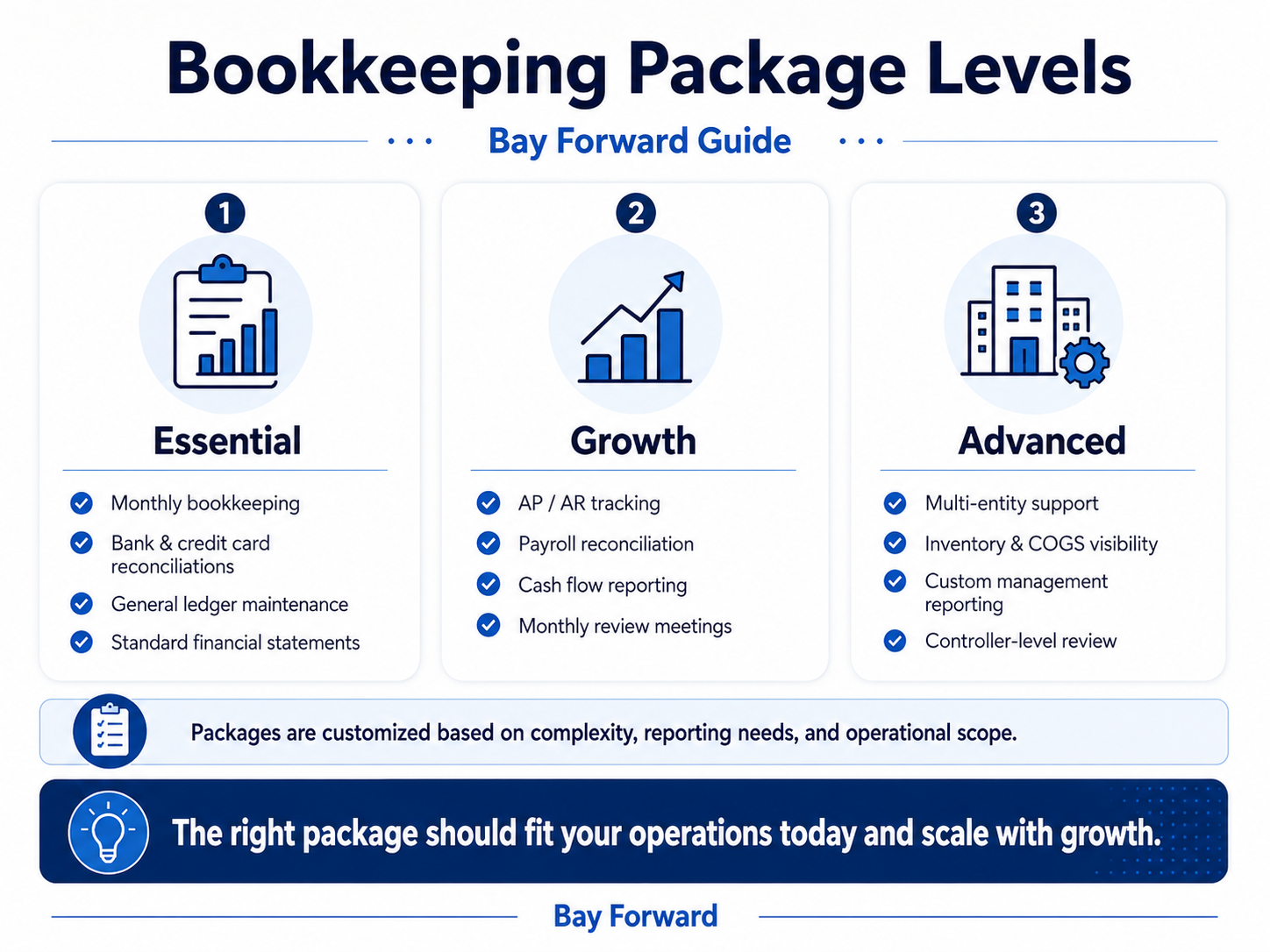
Essential Bookkeeping Package
An essential package is appropriate for companies with straightforward financial activity and limited reporting needs.
It may include:
- Monthly transaction categorization
- Bank and credit card reconciliations
- General-ledger maintenance
- Basic month-end review
- Profit and loss statement
- Balance sheet
- Standard monthly reporting
- Periodic client questions and issue resolution
The final quote would depend on transaction volume, account count, and the condition of the books.
Growth Bookkeeping Package
A growth package is designed for companies with increasing transaction activity, employees, suppliers, customers, or sales channels.
It may include everything in the essential package, plus:
- Accounts payable tracking
- Accounts receivable tracking
- Payroll reconciliation
- Cash-flow reporting
- Expense review
- Monthly management reports
- Financial-review meetings
- Additional account or channel reconciliations
- Coordination with tax professionals
This level provides management with more visibility than basic compliance-oriented bookkeeping.
Advanced Financial Operations Package
An advanced package is suitable for multi-entity, inventory-based, e-commerce, manufacturing, technology, or operationally complex businesses.
It may include:
- Multi-entity bookkeeping
- Consolidated reporting
- Multi-channel reconciliation
- Inventory and cost-of-goods-sold support
- Department or location reporting
- Advanced AP and AR workflows
- Revenue and deferred-revenue support
- Budget-versus-actual reporting
- Cash-flow forecasting support
- Customized management reports
- Controller-level review
- Accounting-system and process optimization
The provider should customize this package around the company’s operational model and management requirements.
Bookkeeping Services That May Cost Extra
A low-priced package may appear attractive until the business discovers that important work is excluded.
Ask whether the following services are included or separately priced:
- Historical bookkeeping cleanup
- Catch-up bookkeeping
- Accounting-system migration
- Chart-of-accounts redesign
- Payroll processing
- Sales-tax support
- 1099 preparation
- Inventory reconciliation
- Multi-currency accounting
- Multi-entity consolidation
- Custom reporting
- Audit support
- Lender reporting
- Budgeting and forecasting
- Accounts payable payment execution
- Customer collection activity
- Fractional controller or CFO support
- Urgent or accelerated month-end closing
Tax preparation and legal advice should not be assumed to be included unless the agreement explicitly states that the provider is qualified and responsible for those services.
Outsourced Bookkeeping vs. Hiring In-House
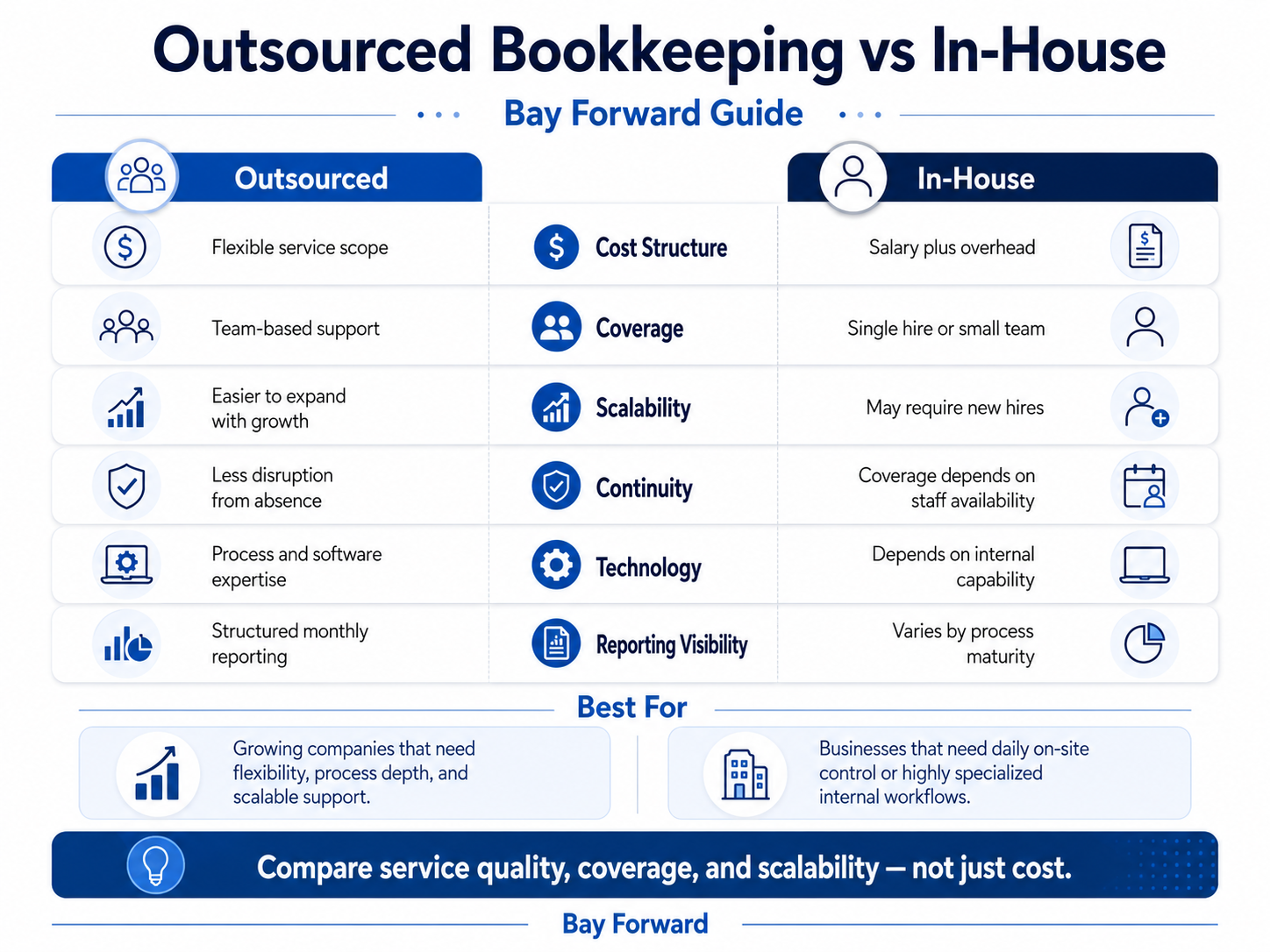
Growing companies frequently compare an outsourced bookkeeping package with hiring an internal employee.
An in-house hire involves more than base salary. The company may also be responsible for recruitment, benefits, payroll taxes, training, software, equipment, management, leave coverage, and replacement risk.
For context, the U.S. Bureau of Labor Statistics reported a median annual wage of $49,210 for bookkeeping, accounting, and auditing clerks in May 2024. This figure represents wages and does not itself include the company’s broader employment overhead.
Outsourcing may provide access to a broader team, documented processes, software knowledge, and continuity without requiring the company to build an internal bookkeeping department immediately.
An internal employee may be more appropriate when the organization needs daily on-site support, direct control over highly specialized processes, or enough recurring work to justify a dedicated position.
The correct decision depends on the required service level, not only the apparent monthly cost.
How to Compare Bookkeeping Package Proposals
Do not compare proposals using the headline price alone.
Ask each provider the same questions:
What Work Is Included?
Request a detailed scope that identifies tasks, reporting deliverables, account limits, and service frequency.
Who Will Perform and Review the Work?
Determine whether the account will be handled by one bookkeeper, a team, or a combination of bookkeepers and senior accounting reviewers.
When Will Monthly Reports Be Delivered?
A report delivered several weeks after month-end may be too late to support management decisions.
Clarify the target close schedule and the responsibilities your internal team must complete before the books can be closed.
How Are Errors and Adjustments Managed?
Ask how reconciliations are reviewed, exceptions are documented, and corrections are approved.
How Will Pricing Change as the Business Grows?
Understand what happens when transaction volume, entities, employees, accounts, or reporting requirements increase.
What Technology Will Be Used?
Confirm which systems the provider supports, who owns the subscriptions and data, and whether integrations or automation are included.
What Is Not Included?
A clear exclusion list is as important as the included services. It helps prevent unexpected charges and responsibility gaps.
Why the Cheapest Bookkeeping Package Can Cost More
The lowest-priced package may become expensive when it produces incomplete, late, or unreliable financial records.
Poor bookkeeping can create:
- Unreconciled cash balances
- Duplicate or missing expenses
- Incorrect customer balances
- Vendor-payment problems
- Unreliable profit reporting
- Delayed tax preparation
- Weak cash-flow visibility
- Difficulty obtaining financing
- Expensive year-end cleanup
The IRS identifies accurate records as necessary for monitoring business progress, preparing financial statements, tracking deductible expenses, preparing tax returns, and supporting reported amounts.
The U.S. Small Business Administration similarly identifies proper bookkeeping and an understanding of business finances as important elements of managing a company effectively.
A professional package should therefore be evaluated according to accuracy, timeliness, control, and management value—not only price.
Get Customized Bookkeeping Package Pricing From Bay Forward
The right bookkeeping package should reflect how your company actually operates.
Bay Forward reviews your transaction activity, accounts, entities, systems, reporting needs, and current bookkeeping condition before recommending a service scope. This allows growing companies to obtain the support they need without paying for irrelevant services or selecting a package that becomes inadequate as the business expands.
Depending on your requirements, Bay Forward can support:
- Transaction recording and categorization
- Bank and credit card reconciliation
- Accounts payable and receivable
- Multi-channel sales reconciliation
- Payroll-related accounting
- Cash-flow management
- Financial statement preparation
- Catch-up bookkeeping
- Budgeting and forecasting support
- Customized management reporting
- Accounting automation and ERP integration
Instead of selecting a generic package based only on company size, Bay Forward develops a customized bookkeeping scope around your financial workload, operational complexity, and reporting priorities.
Request a free bookkeeping consultation with Bay Forward to review your current books, define the required service package, and receive customized pricing for your business.
Frequently Asked Questions
How Much Does a Bookkeeping Package Cost?
The cost depends on transaction volume, number of accounts, number of entities, payroll, inventory, reporting requirements, software complexity, and the condition of the existing books.
What Is Normally Included in Monthly Bookkeeping?
Monthly bookkeeping commonly includes transaction categorization, bank and credit card reconciliation, general-ledger maintenance, account review, and financial statement preparation.
Broader packages may include accounts payable, accounts receivable, payroll reconciliation, cash-flow reporting, and management reporting.
Is Bookkeeping Priced by Revenue?
Revenue may be considered, but it should not be the only pricing factor.
A high-revenue company with few transactions may require less bookkeeping work than a lower-revenue company operating across multiple payment platforms, entities, locations, and inventory systems.
Is Catch-Up Bookkeeping Included in a Monthly Package?
It is commonly treated as a separate initial project because the provider must correct historical records before beginning recurring monthly bookkeeping.
After the books are brought current, the company can move into an ongoing monthly package.
Does a Bookkeeping Package Include Tax Preparation?
Not automatically.
Bookkeeping prepares and maintains the financial records that support tax preparation. Tax filing, tax planning, and tax advice should be separately identified in the engagement scope.
Can a Bookkeeping Package Scale as the Company Grows?
Yes. A customized package can be expanded as the business adds transactions, accounts, employees, entities, inventory, locations, or reporting requirements.
The engagement should define how and when the scope and pricing will be reviewed.