









Manufacturing leaders often compare MRP vs ERP when production planning, inventory control, purchasing, or reporting begins to outgrow spreadsheets and disconnected applications. Both systems can improve operational control, but they solve problems at different levels.
Material requirements planning, or MRP, is primarily concerned with manufacturing demand: what materials are required, how much is needed, and when those materials must be available. Enterprise resource planning, or ERP, connects manufacturing with the wider organization, including finance, procurement, inventory, sales, customer management, projects, human resources, and executive reporting.
The practical difference is therefore not simply one software product versus another. It is a decision about business scope. Do you need a focused production-planning tool, or a connected enterprise platform that links operational activity to financial and commercial outcomes?
This guide explains the difference between MRP and ERP, where their capabilities overlap, and how decision-makers can determine which approach supports their current requirements and future growth.
What Is MRP?
MRP stands for material requirements planning. It is a method and software capability used to calculate the materials required to meet a production plan.MRP vs ERP
A typical MRP calculation uses the master production schedule, bills of materials, inventory balances, open orders, lead times, lot sizes, safety stock, and replenishment rules.
Using this information, the system calculates net material demand and recommends when planners should purchase, produce, release, reschedule, or cancel orders. Oracle describes MRP as a process that evaluates schedules, bills of material, receipts, inventory, lead times, and order rules to determine net requirements and replenishment recommendations.
For a manufacturer, the central purpose of MRP is straightforward: ensure that the right components are available at the right time without carrying unnecessary inventory.
Core MRP Capabilities
Depending on the product, MRP may include bills of materials, demand calculations, production and purchase recommendations, inventory availability, lead-time planning, work-order scheduling, and shortage reporting.
MRP should also be distinguished from MRP II, or manufacturing resource planning. MRP II adds labor, machinery, capacity, and selected financial estimates, but remains centered on manufacturing rather than the full enterprise.
What Is ERP?
ERP stands for enterprise resource planning. An ERP system integrates the core processes and data used to operate an organization.
Rather than managing manufacturing in isolation, ERP connects production activity with functions such as:
- Accounting and financial management
- Procurement and supplier management
- Inventory and warehouse operations
- Sales and order management
- Customer relationship management
- Quality and maintenance
- Project management
- Human resources and payroll
- Compliance, reporting, and analytics
SAP defines ERP as an integrated system that supports core processes including finance, HR, manufacturing, supply chain, sales, and procurement—while providing a unified view of business activity.
In a manufacturing ERP environment, MRP is usually an important module or embedded capability. The ERP receives demand from sales forecasts, customer orders, and production plans; calculates material requirements; generates procurement or manufacturing actions; records inventory movement; and passes the resulting costs and transactions into finance.
This connection is what separates ERP from a standalone planning tool. ERP does not only tell the business what to manufacture. It helps control how that decision affects purchasing, capacity, inventory, customer commitments, cash flow, cost of goods sold, and profitability.
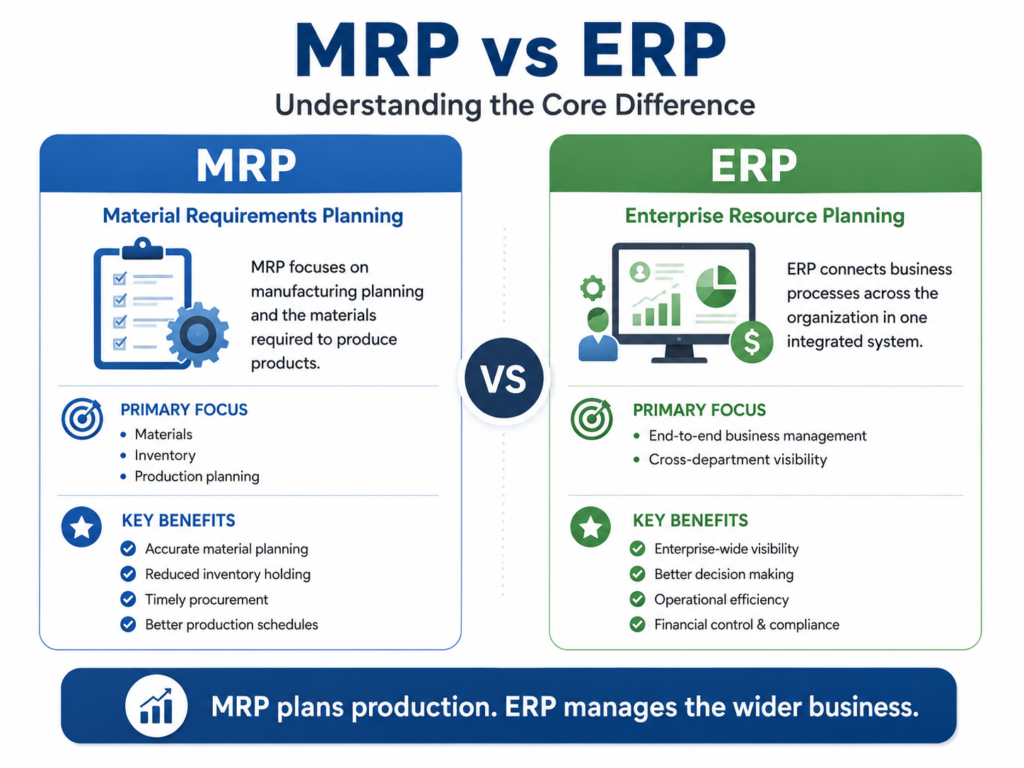
MRP vs ERP: The Main Difference
The main difference between MRP and ERP is functional scope.
MRP focuses on the materials and resources required for production. ERP manages and connects the broader organization, with MRP commonly included as part of its manufacturing functionality.
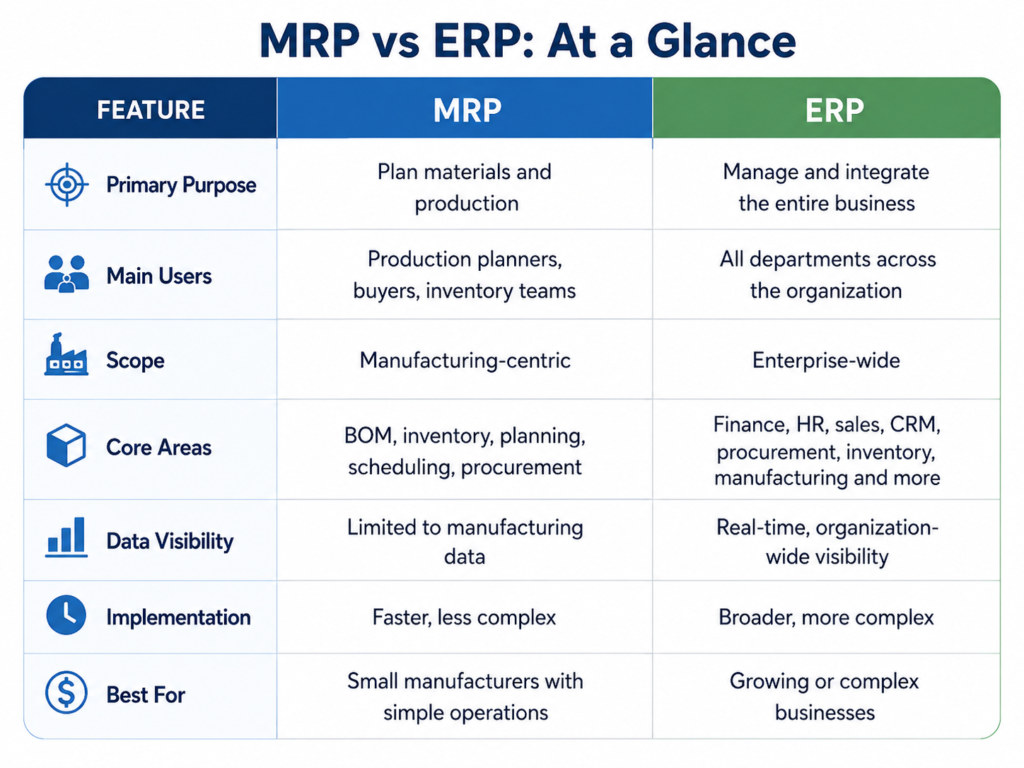
| Comparison Area | MRP | ERP |
|---|---|---|
| Primary purpose | Plan materials and production | Manage connected enterprise operations |
| Main users | Production planners, buyers, and inventory teams | Finance, operations, sales, procurement, HR, leadership, and manufacturing |
| Manufacturing planning | Core capability | Usually included through an MRP or manufacturing module |
| Financial management | Limited or separate | Integrated general ledger, costing, payables, receivables, and reporting |
| Sales and CRM | Usually limited | Connected to demand, orders, forecasts, and customer data |
| Procurement | Focused on production requirements | Enterprise-wide purchasing, suppliers, approvals, contracts, and spend |
| Data model | Primarily manufacturing data | Shared data across departments and entities |
| Reporting | Production and material reports | Operational, financial, commercial, and executive reporting |
| Implementation scope | Narrower and generally faster | Broader and requires cross-functional process design |
| Best fit | Focused manufacturing-planning requirements | Growing or complex businesses requiring enterprise integration |
How MRP and ERP Work Together
MRP and ERP should not always be viewed as competing alternatives. In many modern platforms, MRP operates within ERP.
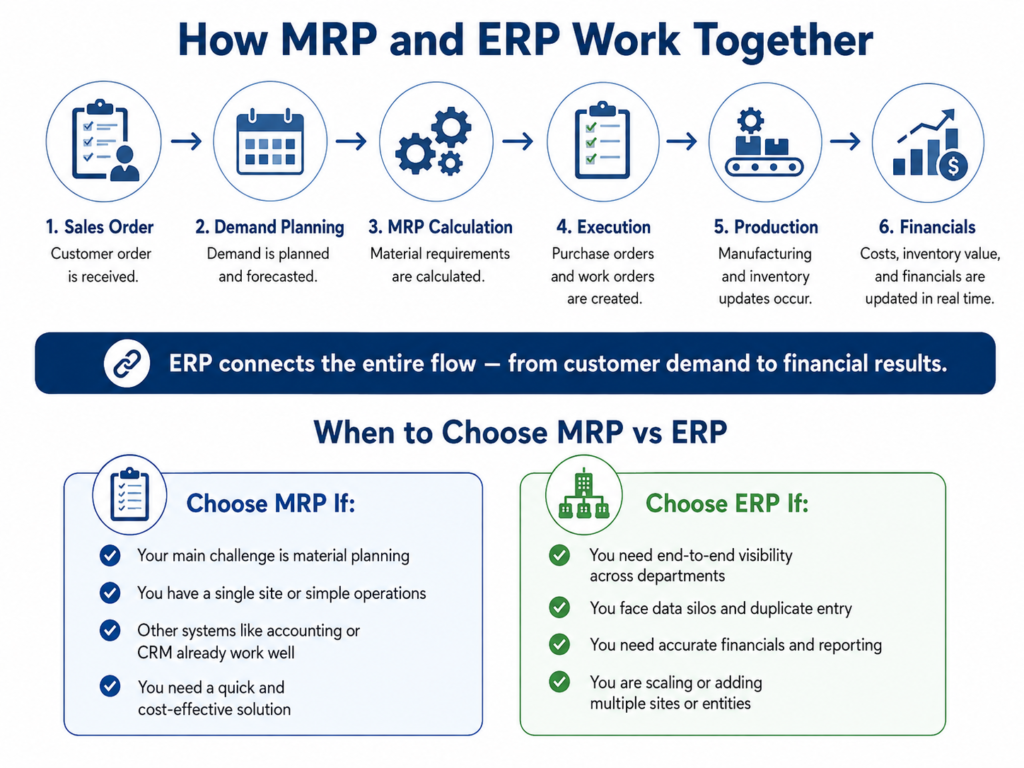
Consider a manufacturer receiving a confirmed customer order. In an integrated ERP workflow:
- Sales records the order and requested delivery date.
- Inventory checks whether finished goods are available.
- MRP reviews the bill of materials and calculates component demand.
- Procurement receives purchase recommendations for missing materials.
- Production receives manufacturing and work orders.
- Warehouse activity records material consumption and finished output.
- Quality inspections and maintenance events are captured.
- Finance records inventory value, labor, overhead, cost of goods sold, revenue, and margin.
- Leadership sees delivery, cost, capacity, and profitability through connected dashboards.
A standalone MRP tool may handle steps three through five effectively. ERP connects those planning decisions to upstream demand and downstream financial results.
This is why current manufacturing ERP platforms commonly position MRP as a foundational capability rather than a separate enterprise architecture. SAP, for example, identifies MRP as a core manufacturing ERP capability while describing ERP as the wider platform connecting planning, operational data, financial outcomes, and supply chain signals.
When Is a Standalone MRP System Enough?
A focused MRP solution may be sufficient when the organization has a clearly defined manufacturing problem and does not need broader system consolidation.
MRP may be the practical choice when:
- Production planning is the immediate operational constraint.
- Accounting, sales, and HR systems already work effectively.
- The company has one site or a relatively simple legal structure.
- Integration requirements are limited.
- The manufacturing team needs faster control over materials and schedules.
- The organization has the resources to maintain separate systems and reconcile data.
For example, a small manufacturer may use an accounting platform that meets its reporting requirements but struggle to plan component purchases from bills of materials. Introducing MRP can reduce spreadsheet-based planning without forcing an enterprise-wide transformation.
However, leaders should evaluate the future architecture before making this decision. A low-cost standalone tool can become expensive when the company later requires custom integrations, duplicate master-data maintenance, consolidated reporting, or migration into a larger ERP platform.
When Does a Business Need ERP?
ERP becomes the stronger choice when manufacturing decisions affect multiple departments and those departments need to operate from consistent data.
A business should consider ERP in the following situations.
1. Production and Finance Do Not Reconcile
If planned material usage, actual consumption, inventory value, labor, overhead, and product margin are calculated in separate systems, leadership may receive conflicting results.
ERP connects operational transactions to accounting and cost reporting, helping finance and production work from the same underlying records.
2. Teams Repeatedly Enter the Same Data
Re-entering customers, products, orders, suppliers, bills of materials, receipts, and invoices creates delays and control risks.
ERP establishes shared records and automated workflows so that information recorded in one department can trigger the appropriate activity elsewhere.
3. Inventory Visibility Is Unreliable
Manufacturers operating multiple warehouses, production sites, subcontracting locations, or distribution centers need a coordinated view of raw materials, work in progress, and finished goods.
Without connected inventory data, planners may purchase materials that are already available, commit unavailable stock to customers, or delay production because inventory is recorded in the wrong location.
4. Customer Commitments Are Disconnected From Capacity
Sales teams can promise delivery dates without understanding material shortages, machine availability, production queues, or supplier lead times.
ERP links customer demand to inventory, procurement, production schedules, and operational constraints, providing a more reliable basis for delivery commitments.
5. The Business Is Adding Entities, Sites, or Product Lines
Growth increases the complexity of approvals, intercompany activity, reporting, costing, tax structures, and master data.
ERP provides a more scalable operating model for companies expanding into new locations, legal entities, product categories, markets, or sales channels.
6. Management Reporting Requires Manual Consolidation
When executives depend on exported spreadsheets to combine operational and financial information, reporting is slow and difficult to validate.
ERP supports common definitions and traceable transactions, enabling management to evaluate production, inventory, purchasing, sales, costs, and profitability within a connected reporting environment.
MRP vs ERP: Cost and Implementation Considerations
MRP usually has a narrower implementation footprint. ERP requires more design because it affects multiple departments, data domains, controls, and reporting structures.
The correct comparison should therefore consider total cost of ownership, not software subscription fees alone.
MRP costs may include licenses, integrations, duplicate-data maintenance, custom reporting, middleware support, reconciliation, and future migration.
ERP costs may include licensing or hosting, process design, configuration, data migration, integrations, testing, training, change management, and post-go-live support.
ERP often requires a greater upfront commitment, but it may reduce the long-term cost and operational friction of maintaining fragmented applications.
The business case should measure outcomes such as:
- Inventory reduction
- Planning accuracy
- Schedule adherence
- Procurement efficiency
- Faster financial close
- Improved margin visibility
- Reduced manual work
- Better order fulfillment
- Lower integration maintenance
- More reliable management reporting
Decision-makers should also assess implementation risk. A smaller system is not automatically less risky if it requires several integrations or leaves important processes dependent on spreadsheets.
Likewise, a broader ERP project should not attempt to transform every business process at once. A phased implementation can prioritize manufacturing, inventory, procurement, finance, or other functions according to business value and readiness.
Key Questions to Ask Before Choosing MRP or ERP
Decision-makers should avoid selecting software from a feature checklist alone. The right choice depends on the operating model the company is trying to build.
Which Departments Must Share Data?
If manufacturing can operate independently, MRP may be enough.
If sales, purchasing, finance, warehouses, service, and production depend on the same transactions, ERP is usually more appropriate.
Map how information moves from customer demand to planning, purchasing, production, delivery, invoicing, and financial reporting. This reveals whether the requirement is departmental or enterprise-wide.
How Complex Is the Manufacturing Model?
Evaluate the manufacturing models the system must support, including:
- Make-to-stock
- Make-to-order
- Engineer-to-order
- Configure-to-order
- Process manufacturing
- Discrete manufacturing
- Subcontracting
- Co-products and by-products
- Multi-level bills of materials
- Routings and work centers
- Quality inspections
- Capacity constraints
A system that works for simple assembly may not support complex routings, variable yields, subcontracted operations, or regulated traceability.
Can the Business Trust Its Master Data?
MRP results depend heavily on accurate bills of materials, inventory, lead times, and schedules. Oracle’s planning documentation emphasizes that data accuracy is essential to effective MRP output.
ERP does not automatically correct poor data. Instead, it makes data governance more important because inaccurate information can affect multiple departments.
Before implementation, businesses should review:
- Product records
- Bills of materials
- Units of measure
- Routings
- Work centers
- Supplier lead times
- Replenishment rules
- Inventory balances
- Customer and supplier records
- Financial dimensions
- Chart of accounts
What Will Change Over the Next Three to Five Years?
Consider expected sites, entities, users, channels, product complexity, acquisitions, compliance obligations, and reporting requirements.
A system that fits today but blocks planned growth is not a low-cost choice.
The technology should support the expected operating model without requiring excessive customization or another major replacement project within a short period.
Common MRP and ERP Selection Mistakes
Treating ERP as Only an IT Project
ERP changes processes, responsibilities, approvals, controls, and reporting. Business ownership is essential.
Operations, manufacturing, supply chain, finance, sales, and executive stakeholders should participate in requirements, design decisions, testing, and adoption.
Automating Inefficient Processes
Software will not fix unclear planning rules, inaccurate bills of materials, weak inventory controls, or inconsistent purchasing.
Before configuration begins, the organization should define how demand is generated, how production is planned, who owns master data, how exceptions are resolved, and which controls are required.
Customizing Too Early
Customization should support a genuine competitive, operational, or regulatory requirement.
Recreating every legacy workflow increases implementation cost, testing effort, maintenance, and upgrade risk. Businesses should use standard capabilities wherever they adequately support the required outcome.
Ignoring Data and Outcome Readiness
Master data should be cleaned before migration, while the project should have measurable targets, owners, baselines, and acceptance criteria—not only a module list.
Examples of measurable ERP or MRP objectives include:
- Reduce inventory shortages.
- Increase schedule adherence.
- Improve inventory accuracy.
- Reduce planning time.
- Shorten purchasing cycles.
- Improve on-time delivery.
- Accelerate financial closing.
- Improve product-level margin reporting.
Which Is Better: MRP or ERP?
Neither system is universally better.
MRP is better when the business needs a focused solution for material and production planning and can operate effectively with separate supporting systems.
ERP is better when the business needs manufacturing to operate as part of a connected enterprise, where production decisions must align with sales, procurement, inventory, finance, customer service, and strategic reporting.
For many growing manufacturers, the most sustainable model is an ERP platform with integrated MRP capabilities.
This preserves the manufacturing depth required by planners while giving leadership broader operational and financial control.
Build the Right Manufacturing System With Bay Forward
The most important decision is not whether a product carries an MRP or ERP label. It is whether the system supports your manufacturing model, data requirements, controls, reporting needs, and growth strategy.
Bay Forward helps organizations assess, implement, integrate, customize, and optimize manufacturing ERP and MRP environments. Its current ERP portfolio includes Odoo and Oracle platforms such as NetSuite, enabling the solution approach to be aligned with operational complexity rather than forced into a single technology.
A structured assessment can determine:
- Which processes should remain standard
- Which manufacturing capabilities are essential
- Whether standalone MRP is sufficient
- Where ERP integration will create measurable value
- What data must be corrected before implementation
- Which platform best fits the company’s scale and operating model
- How to phase deployment while controlling risk
Unsure whether your business needs MRP, ERP, or a combined manufacturing platform? Schedule a consultation with Bay Forward to evaluate your current systems, define the right scope, and build a practical ERP roadmap.
Frequently Asked Questions
Is MRP Part of ERP?
In many modern manufacturing ERP systems, yes.
MRP is commonly included as the planning capability that calculates material demand and recommends production or purchasing actions. ERP extends that capability across finance, sales, procurement, inventory, HR, and other business functions.
Can ERP Replace MRP?
An ERP can replace a standalone MRP product when its manufacturing module supports the company’s required planning, bills of materials, routings, capacity, traceability, and shop-floor processes.
The fit should be validated through detailed requirements, demonstrations based on real business scenarios, and process testing.
What Is the Biggest Benefit of ERP Over MRP?
The biggest benefit is enterprise-wide integration.
ERP connects manufacturing plans and transactions with financial, commercial, procurement, inventory, and management data, giving decision-makers a more complete view of business performance.
Should a Small Manufacturer Choose MRP or ERP?
A small manufacturer with limited complexity may begin with MRP.
However, ERP can be the better option when the business already requires integrated accounting, sales, purchasing, inventory, and production—or expects to scale rapidly.
The decision should be based on process complexity and integration requirements rather than company size alone.