




















Oracle NetSuite is the stronger fit for upper mid-market and enterprise companies with multi-entity consolidation, ASC 606 revenue recognition, or pre-IPO audit requirements. Odoo is the stronger fit for SMB and mid-market companies that need fast deployment, lower total cost of ownership, and deep operational customization. The decision is driven less by feature lists and more by company stage, finance complexity, and how much the business needs the ERP to bend around unique workflows.
Table of Contents
Key Takeaways
- NetSuite serves enterprise scale with native multi-subsidiary consolidation, audit-ready controls, and SuiteSuccess industry baselines.
- Odoo serves SMB to mid-market with modular per-app pricing, faster time to value, and full source-code access for customization.
- Three-year TCO typically favors Odoo at single-entity scale and NetSuite at multi-entity scale once compliance and consolidation costs are priced in.
- Implementation runs 3 to 6 months for Odoo and 6 to 12 months for NetSuite in scaling-company scopes.
- Stage of growth is a better decision driver than feature comparison alone.

NetSuite vs Odoo at a Glance
NetSuite is a cloud-only multi-tenant ERP owned by Oracle, built around a single platform philosophy: standardize on best-practice finance and operations workflows. Strongest in upper mid-market and enterprise organizations with complex revenue recognition, multi-subsidiary consolidation, and audit-grade reporting needs.
Odoo is an open-source modular ERP available in Community and Enterprise editions, structured as 80+ apps that activate as the business needs them. The architecture is built for adaptation rather than standardization, which is why it dominates among SMB and mid-market companies with unusual or rapidly evolving workflows.
Side-by-Side Comparison: NetSuite vs Odoo
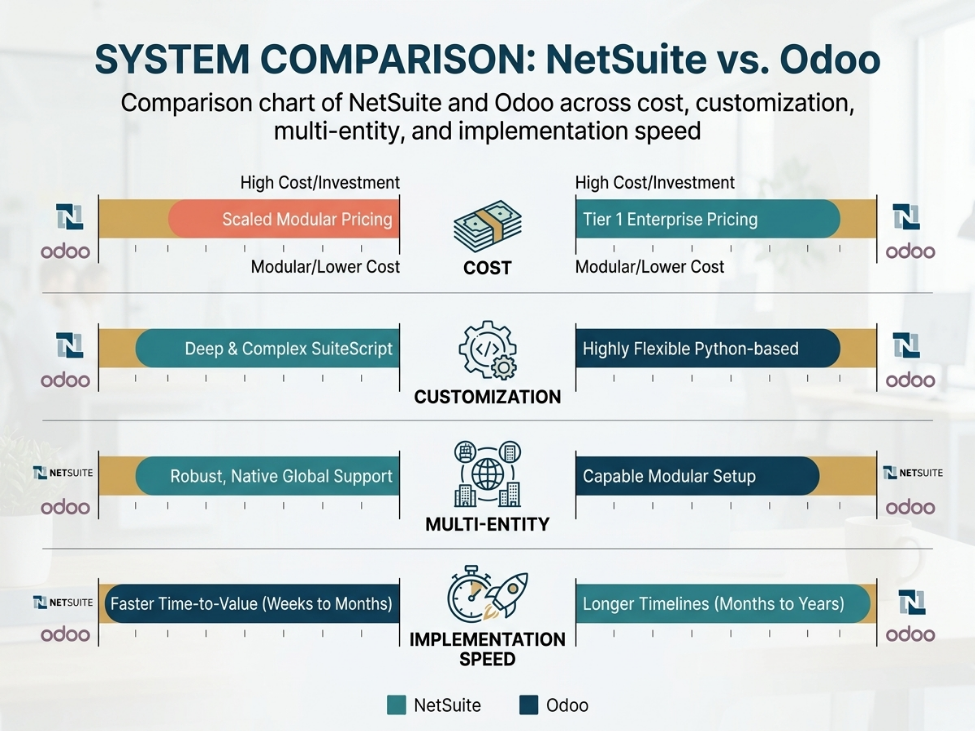
| Dimension | Oracle NetSuite | Odoo Enterprise |
|---|---|---|
| Best fit by revenue | USD 25M and above | USD 2M to 250M |
| Deployment | Cloud SaaS only | Cloud, on-premise, or hybrid |
| Licensing | Per-user plus module bundles, annual | Per-user-per-app, monthly or annual |
| Customization framework | SuiteCloud, SuiteScript, SuiteFlow | Open-source Python, full source access |
| Multi-entity consolidation | Native, audit-ready | Available, partner-configured |
| Implementation time | 6 to 12 months | 3 to 6 months |
| Industry baselines | SuiteSuccess templates | Vertical modules and partner accelerators |
| AI capabilities | Bill Capture, Text Enhance, Analytics Warehouse | Native automation, OCR, plus open AI integration |
When NetSuite Is the Right Choice
- Multi-entity consolidation at scale. Five or more legal entities, multiple currencies, and intercompany flows benefit from NetSuite’s native consolidation engine and audit trail.
- Complex revenue recognition. Subscription, professional services, and contract manufacturing businesses with ASC 606 or IFRS 15 obligations get materially less risk from NetSuite’s built-in module.
- IPO and institutional audit posture. SOX-style controls are documented out of the box, and the platform is well understood by Big Four auditors.
When Odoo Is the Right Choice
- Deep operational customization. Companies whose edge sits in unusual workflows (custom routings, niche service patterns, blended B2B/B2C commerce) gain from Odoo’s open framework without fighting platform constraints.
- Per-app cost control. License cost scales smoothly with adoption rather than stepping up at enterprise tiers, which protects cash flow during growth.
- Speed to value. A well-scoped Odoo Enterprise rollout typically goes live in a quarter or two, fitting inside a single planning cycle or funding window.
Total Cost of Ownership: 3-Year View
| Cost component (50 users, mid-complexity) | NetSuite | Odoo Enterprise |
|---|---|---|
| Licenses and subscriptions | USD 180,000 to 360,000 | USD 36,000 to 90,000 |
| Implementation and configuration | USD 120,000 to 300,000 | USD 60,000 to 180,000 |
| Customization and integrations | USD 60,000 to 200,000 | USD 40,000 to 150,000 |
| Annual support and optimization | USD 40,000 to 90,000 per year | USD 20,000 to 60,000 per year |
Ranges shift with scope, geography, and partner quality. The pattern holds: Odoo’s TCO advantage is widest in the first 24 months and narrows once multi-entity, advanced reporting, and compliance requirements accumulate. Independent ERP market research from Gartner confirms the same split between SaaS-locked and modular open-source ERP categories at the architecture level.
Not sure which platform fits your stage?
Bay Forward implements both NetSuite and Odoo. A 30-minute scoping call will map your structure, finance complexity, and growth plan
ERP Choice by Stage of Growth
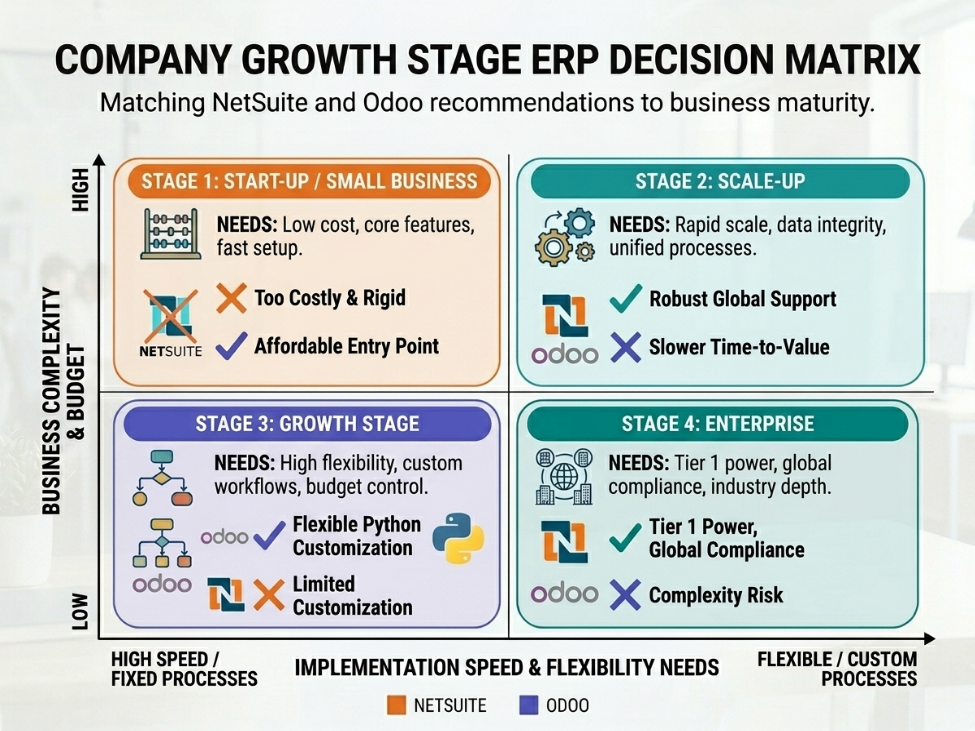
Early growth, single entity, USD 2M to 15M. Odoo Enterprise almost always wins. License cost scales smoothly and deployment fits a single planning cycle.
Scaling mid-market, single or dual entity, USD 15M to 50M. This is the genuine decision point. Moderate finance complexity favors Odoo; emerging multi-entity or revenue recognition needs tilt toward NetSuite.
Multi-entity, USD 50M to 250M. NetSuite typically wins, particularly with international subsidiaries, multi-currency reporting, or institutional investor reporting. Odoo can still work with a strong partner, but the marginal cost of adding missing capabilities closes the TCO gap.
Enterprise, USD 250M and above. NetSuite, Oracle Fusion Cloud, or another tier-one ERP are the practical options.
Don’t hesitate any longer – seize the opportunity to recruit top talent today!
How Bay Forward Implements NetSuite and Odoo
Bay Forward is an Odoo Silver Partner and Oracle NetSuite implementation partner, founded in 2014, with 200+ professionals serving more than 520 clients across five continents. Delivery teams operate from the United States, Canada, and Ireland, with consultants certified across Odoo, QuickBooks (ProAdvisor), and accounting credentials including ACCA and CPA.
Because the firm implements both platforms, recommendations are driven by the client’s stage and finance complexity rather than a single-platform commercial incentive. Engagements run through five service phases that apply equally to NetSuite and Odoo: integration, implementation, customization, functional support, and development. A recent Odoo deployment for a distribution client reduced manual tasks by 40 percent and improved inventory accuracy alongside faster invoicing and order processing.
For Odoo clients, work often extends into AI automation through OneClickBooks for accounting and the broader Odoo ecosystem at OneStopOdoo. For NetSuite clients, it covers SuiteSuccess configuration, custom SuiteScript development, and post-go-live optimization.How Bay Forward Implements NetSuite and Odoo
Frequently Asked Questions
Is Odoo cheaper than NetSuite?
Odoo is typically 60 to 80 percent cheaper than NetSuite at the license level and 30 to 50 percent cheaper at the implementation level. Three-year TCO usually favors Odoo for single-entity SMB and mid-market companies. NetSuite closes the gap once multi-entity consolidation, advanced compliance, and audit-grade reporting are required.
Can Odoo replace NetSuite?
Yes, in many scenarios, particularly for single or dual-entity companies with moderate finance complexity. Replacement is more complex for multi-subsidiary enterprises because NetSuite’s native consolidation and revenue recognition capabilities take careful planning to reproduce through Odoo custom modules and integrations.
How long does each implementation take?
Odoo Enterprise implementations typically take 3 to 6 months for a scaling-company scope. NetSuite implementations typically take 6 to 12 months. Both timelines shrink with disciplined scope and grow when integration and data-migration work is underestimated.
Which ERP is better for eCommerce companies?
Odoo is often the stronger fit because its native Sales, Inventory, eCommerce, and Accounting integration reduces the need for third-party connectors. NetSuite offers SuiteCommerce, which is powerful but more expensive to implement and maintain.
Should a Series B or Series C company default to NetSuite?
Not automatically. Series B and C companies preparing for institutional audit, anticipating an IPO, or operating multiple subsidiaries usually benefit from NetSuite’s audit posture. Single-entity companies with strong operational differentiation often get more value from Odoo for another 18 to 24 months before reassessing.