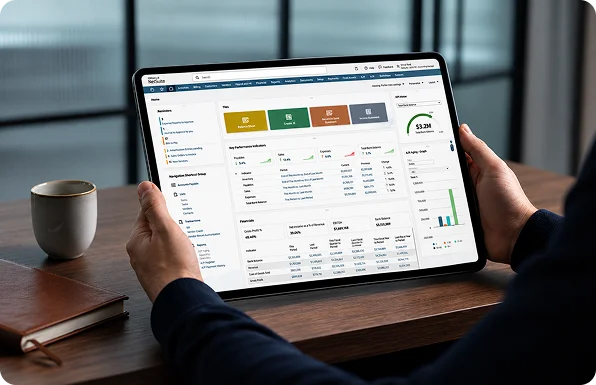
















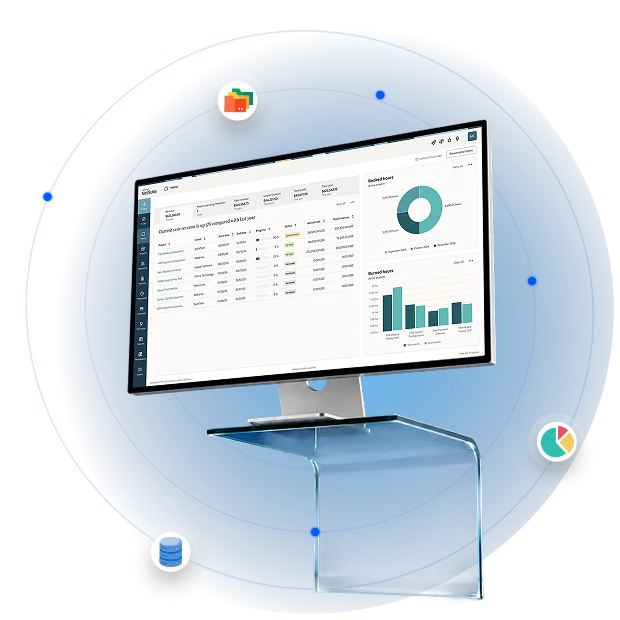
NetSuite Implementation Services Built for Scalable Growth

NetSuite implementation is the process of configuring Oracle NetSuite as your system of record for finance, inventory, orders, and reporting, then migrating validated data into it and proving the results before go-live.

Bay Forward delivers that work as a controlled project with defined phases, approval points, and reconciliation checks. Finance, CRM, inventory, order management and reporting run on one cloud platform after cutover.

Upgrade to a Controlled NetSuite ERP
Implementation with Bay Forward

Six conditions signal that a business has outgrown its current systems: transaction volume exceeds what the accounting system handles cleanly, month-end close takes longer than 10 business days, inventory and order data live outside the ledger, subsidiary consolidation runs in spreadsheets, reporting requires manual assembly, and integrations between systems are maintained by hand. A structured NetSuite ERP implementation replaces those conditions with a single reconciled platform.

Automate Financial Processes

Replace spreadsheet workflows with automated approvals, recurring journals and bank reconciliation inside NetSuite.

Unify & Centralize Data

Hold inventory, customer, order and financial records in one database so reporting draws from a single source.

Accelerate Financial Close

Standardize the close checklist, automate intercompany entries and consolidate subsidiaries without manual worksheets.

Real-Time Visibility

Publish role-based dashboards and KPIs for finance, operations and executives, refreshed from live transaction data.

Controlled ERP Delivery

Bay Forward delivers NetSuite for CFOs, Controllers, COOs and IT Directors who need a governed project, not a configuration exercise. Every phase carries named owners, deliverables and an approval gate.

Group 2085664681 1 Group 2085664681 2 Group 2085664681 3 Group 2085664681 4 Group 2085664681 5

NetSuite Implementation Services We Provide

Discovery and Requirements Gathering

We document your current systems, close process, reporting requirements, integration dependencies, and data quality. Source systems we migrate from include QuickBooks, Sage Intacct, Xero, Microsoft Dynamics GP, Oracle EBS, and spreadsheet-based processes. Output includes a baseline scope, a decision log, and a data readiness assessment.

Business Process and Solution Design

Our consultants convert requirements into future-state processes and a NetSuite solution architecture covering the chart of accounts, subsidiary structure, roles, item and customer records, and approval routing. A fit-gap analysis separates native functionality from configuration and justified customization.

Configuration and Technical Delivery

We configure NetSuite around approved processes rather than reproducing legacy limitations. Work covers forms, roles and permissions, SuiteFlow workflows, saved searches, dashboards, and SuiteScript where native functionality cannot meet a documented requirement.

Data, Testing and Deployment

We run trial migrations, reconcile balances, execute system testing and user acceptance testing, and then train users by role before cutover. The final scope depends on your modules, entities, data history, integrations, customization, and internal resource availability.

NetSuite Capabilities We Configure and Deploy

Bay Forward configures 6 NetSuite capability areas that connect financial management to daily operations. Scope is set per engagement, and additional modules including SuitePeople, Warehouse Management, Demand Planning and SuiteBilling are configured where requirements justify them.

Capability
01

Financial Management

General ledger, accounts payable, accounts receivable, billing, fixed assets, bank reconciliation, period close, and management reporting. Advanced Revenue Management is configured where ASC 606 recognition schedules apply.

Frame 2147207517 5
Capability
02

NetSuite OneWorld

Subsidiaries, multiple currencies and exchange-rate handling, consolidated reporting, country-specific localizations, intercompany transactions and elimination entries.

Frame 2147207517 1
Capability
03

Order and Inventory Management

Sales orders, fulfillment, purchasing, item records, multi-location inventory, landed cost, returns and replenishment. Ecommerce, marketplace and 3PL connections are handled in the integration phase.

Frame 2147207517 2
Capability
04

CRM

Lead, opportunity, customer, and sales activity management are joined to quotes, sales orders, and invoices, so pipeline and revenue read from the same records.

Frame 2147207517 3
Capability
05

Project Accounting

Projects, time entry, expenses, resource allocation, project billing and project profitability reporting for services and delivery teams.

Frame 2147207517 4
Capability
06

Reporting and Analytics

Role-based dashboards, KPIs, saved searches, and financial reports for finance, operations, and executive users. NetSuite Analytics Warehouse is scoped for cases where reporting needs exceed native search and dashboard capabilities.

Frame 2147207517 5

NetSuite Implementation Methodology: 7 Controlled Phases

A NetSuite implementation runs across 7 phases, and each phase closes with a named deliverable and a written approval. US mid-market implementations typically run 12 to 16 weeks for a single-entity financials scope and 4 to 6 months where multiple subsidiaries, heavy integration or custom development are in scope. The 2026 ERP Report from Panorama Consulting Group, covering 170 organizations at a median annual revenue of $200.5 million, recorded a 9-month median timeline across all ERP platforms, with more than a quarter of projects running over budget. Bay Forward controls scope, data, configuration, testing and user readiness to keep a project inside its committed window.

Step 1

Discovery and Planning

We assess current systems, reporting gaps, data sources, integration dependencies and internal capacity. Deliverables: baseline scope, implementation roadmap, governance plan and a RACI for every workstream. Typical duration is 2 to 4 weeks.

Step 2

Business Process Design

We map future-state financial and operational processes, then run a fit-gap analysis that separates native NetSuite functionality from configuration and from justified customization. Every gap is logged with an owner and a decision date.

Step 3

Solution Architecture and Configuration

We configure your NetSuite sandbox: subsidiaries, chart of accounts, roles, permissions, forms, SuiteFlow workflows, saved searches and dashboards. SuiteScript is used only where it solves a documented requirement. Configuration is scheduled around your NetSuite release calendar, since Oracle upgrades every account twice a year on an assigned date.

Step 4

Data Migration

We map, cleanse and validate customer, vendor, item, open transaction and historical financial data before migration. Trial loads, record-count comparisons and opening-balance checks run before final cutover. Migration from QuickBooks, Sage Intacct, Xero, Dynamics GP and legacy ERP platforms is handled with source-specific mapping templates.

Step 5

Integration Delivery

We connect NetSuite to e-commerce, CRM, payment, banking, payroll, tax, logistics, and warehouse systems using SuiteTalk REST and SOAP APIs, SuiteScript RESTlets, and integration platforms including Celigo and Boomi. Common connections include Shopify, Amazon, Salesforce, HubSpot, Avalara, ADP, EDI providers, and 3PL warehouse systems. Every integration is validated against real business scenarios before production release. See our data engineering services, where pipeline work sits outside the ERP.

Step 6

Testing and Training

We validate financial postings, workflows, integrations, permissions and reporting through system testing and business-led user acceptance testing. Role-based training covers the transactions each team runs daily, not a generic system tour.

Step 7

Cutover, Go-Live and Hypercare

The cutover plan covers final migration, opening balances, user access, integration activation, and a formal go/no-go decision. Cutover dates are checked against your NetSuite upgrade window so a release does not land mid-transition. Hypercare then covers issue resolution, first-close reconciliation, and system stabilization before handover to ongoing NetSuite support.

How We Control NetSuite Implementation Risk

ERP projects lose control for 6 recurring reasons: requirements stay unwritten, data work starts too late, customization expands past the business case, accounting controls are skipped, users are trained too close to go-live, and testing is cut to protect a date. Bay Forward applies a named control against each one.

Unclear Requirements

Signed requirements baseline, written decision log, and formal change control on every scope addition.

Poor Data Quality

Named data owners per object, validation rules applied before load, and a minimum of 2 trial migrations before cutover.

Excessive Customization

Configuration-first design, a business case required for each SuiteScript item, and dependency mapping before build.

Accounting Errors

Subledger to general ledger reconciliation, opening balance verification, and a controlled first close with our finance team present.

Low User Adoption

Role-based training tied to daily transactions, and user acceptance testing run by the business rather than by consultants.

Risky Cutover

Written readiness criteria, a sequenced cutover checklist, a go/no-go approval, and a rollback position held until the first close reconciles.

NetSuite Release Planning During and After Implementation

Oracle ships 2 NetSuite releases a year and applies them to your account on an assigned upgrade date, so an implementation plan has to account for the release calendar. The 2026.1 release introduced Intelligent Close Manager and AI agents across account reconciliation, planning and budgeting, and profitability and cost management. The 2026.2 release began the rollout of NetSuite Next and the Ask Oracle assistant to US and Canada accounts, and started the countdown on authentication changes landing in 2027.1. Bay Forward tests your configuration, customizations and integrations in the Release Preview account before each upgrade reaches production, so a release never arrives as a surprise mid-project or mid-close.

Why Choose Bay Forward as Your NetSuite Implementation Partner?

Evaluate a NetSuite implementation company on 5 criteria: accounting control design, operational process depth, data architecture, integration capability and user adoption method. Configuration skill alone does not protect a close. Bay Forward’s consulting heritage includes former PwC CPAs, finance specialists and technical architects, and the same team runs outsourced accounting engagements, so the people designing your controls also operate them. Bay Forward implements both NetSuite and Odoo, which means our platform recommendation is not tied to a single vendor’s licence revenue. Businesses still deciding between the two get a fit assessment before committing budget.

Finance &
Process

  • Finance-led process and control design
  • Data validation and reconciliation
  • Close calendar and subledger design
  • ASC 606 revenue recognition configuration

NetSuite
Solution

  • NetSuite solution architecture
  • Configuration-first implementation
  • SuiteFlow and SuiteScript capability
  • OneWorld multi-subsidiary and multi-currency setup

Integration &
Delivery

  • API and middleware integration experience across Celigo, Boomi and SuiteTalk
  • Transparent project governance with written approval points
  • Role-based training built around daily transactions

Implementation
Support

  • Cutover and hypercare support through the first close
  • Onsite, hybrid and remote delivery models
  • Release Preview testing before every NetSuite upgrade

Start with our NetSuite consultation service and build a practical implementation plan around your organization’s real requirements.

NetSuite Implementations for Your Operating Model

Industry determines your controls, data structure and workflow design. Bay Forward builds around your operating model rather than a packaged industry template. We implement NetSuite for 8 sectors:

NetSuite Implementation Proof You Can Evaluate

Ask any NetSuite implementation partner for 7 pieces of evidence before you approve a project. Bay Forward supplies all 7 under NDA and structures the shortlist conversation around them:

  • Legacy system and business challenge
  • Entities, users and modules implemented
  • Data and integration scope
  • Reconciliation controls
  • Cutover approach
  • Go-live results
  • Measurable operational outcomes

Published engagements are available in our NetSuite and ERP success stories.

Group 2085664681

NetSuite Implementation Services FAQs

The engagement can include discovery, process design, solution architecture, NetSuite configuration, data readiness, integrations, testing, training, cutover, go-live and hypercare. The final scope depends on your entities, modules, data, integrations and customization requirements.

The timeline depends on system complexity, data quality, modules, subsidiaries, integrations and the availability of your internal team. Bay Forward confirms the schedule after discovery instead of applying one timeline to every implementation.

Major cost drivers include the number of modules and entities, data volume, integration complexity, SuiteScript development, testing requirements, training needs and rollout approach. A defined scope provides a more reliable estimate than a generic implementation package.

SuiteSuccess is an industry-aligned implementation approach that uses leading practices, predefined processes, roles, dashboards and reports. It can accelerate delivery when requirements align with standard functionality, while still requiring data preparation, validation, training and cutover planning.

Your organization should assign an executive sponsor, project manager, process owners, data owners and UAT users. Timely decisions, reliable source data and active participation are critical to implementation quality and schedule control.

Validation can include trial loads, record-count comparisons, opening-balance checks and reconciliation between accounts receivable, accounts payable, inventory, fixed assets and the general ledger.

Yes. NetSuite can connect with CRM, ecommerce, payment, banking, logistics and other platforms through SuiteTalk REST or SOAP APIs, middleware and approved connectors. Integration scope and ownership should be defined early in the implementation.

Customization should solve a justified requirement that native configuration cannot address. Bay Forward prioritizes standard functionality and SuiteFlow before introducing SuiteScript or more complex custom records.

Hypercare focuses on stabilization, issue triage, reconciliation and user support. After the agreed hypercare period, responsibility can transition to your internal team or an ongoing NetSuite support and managed services engagement.

Plan a Controlled
NetSuite Go-Live

A NetSuite go-live should deliver a reconciled ledger, tested workflows, validated reporting, stable integrations and named system owners. Bay Forward’s NetSuite consulting team assesses your current systems, implementation requirements, data readiness and go-live risks, then returns a scope, a schedule and a risk register you can approve. Book the consultation to start that assessment.