





















Enterprise resource planning (ERP) implementation failure occurs when a deployment misses its business objectives, exceeds budget or timeline, delivers unusable processes, or fails to achieve measurable adoption. Industry analyses consistently show that a significant portion of large-scale ERP projects fall short of expectations, creating urgent operational and financial risk for organizations pursuing digital transformation. This article explains the ten most common causes of ERP implementation failures, the mechanisms by which each problem arises, and clear, practitioner-tested steps to avoid those pitfalls.
You will find a prioritized checklist, targeted mitigation tactics (including data and change practices), and governance models that leadership can adopt to reduce risk. The following sections map the common failure causes, examine data migration and governance in depth, explore scope and vendor issues, cover testing and communication, and finish with an actionable success checklist and how an integrated consulting approach supports durable outcomes.
Table of Contents
What Are the Most Common Causes of ERP Implementation Failures?

Poor planning, insufficient change management, and flawed data migration are recurring failure drivers in ERP projects; these failures propagate through scope creep, weak sponsorship, over-customization, inadequate testing, poor vendor fit, ineffective communication, and employee resistance. Understanding these root causes clarifies where to invest attention and which controls to apply during each phase of implementation. Below is a concise enumeration of the ten primary failure reasons, each with a one-sentence impact statement to aid rapid triage and prioritization.
- Poor planning and unclear objectives: Misaligned scope and undefined KPIs produce mismatched deliverables and low ROI.
- Inadequate change management: Weak training and communication yield low user adoption and process divergence.
- Data migration challenges and poor data quality: Dirty or mismapped data breaks transactions and reporting continuity.
- Lack of executive sponsorship and resource allocation: Slow decisions and underfunding stall deployments and reduce priority.
- Scope creep and over-customization: Growing requirements inflate costs and create technical debt.
- Unrealistic timelines and budget overruns: Rushed rollouts sacrifice testing, causing defects and rework.
- Insufficient testing and QA: Unaddressed defects disrupt operations and require costly hotfixes.
- Poor vendor selection and partnership: Mismatched vendor capabilities lead to delivery gaps and knowledge silos.
- Ineffective communication across stakeholders: Fragmented information flows cause misaligned expectations and delays.
- Employee resistance and cultural friction: Resistance undermines adoption and leaves processes partially implemented.
This table summarizes five of these failure reasons, their typical root causes, and practical mitigation steps to prioritize early in a program.
| Failure Reason | Typical Root Causes | Sample Mitigation Steps |
|---|---|---|
| Poor planning and unclear objectives | Incomplete requirements, missing KPI definition, no success criteria | Invest in discovery workshops, define SMART KPIs, produce a signed scope document |
| Inadequate change management | Limited training, no stakeholder engagement, weak communications plan | Build a change plan, create training curricula, appoint change champions |
| Data migration failures | Legacy format mismatch, duplicate records, missing mapping rules | Run data profiling, automate cleansing, validate with reconciliation tests |
| Scope creep/over-customization | Uncontrolled change requests, no governance, feature parity demands | Implement change control board, prefer configuration over customization, freeze core scope |
| Lack of executive sponsorship | No steering committee, delayed approvals, no clear prioritization | Secure sponsor commitment, define escalation paths, schedule governance cadence |
This snapshot clarifies where initial investments deliver disproportionate risk reduction and sets the stage for deep dives into the top failure drivers. The next sections examine the planning and change management failures in detail and recommend practical remediation checklists.
How Does Poor Planning and Unclear Objectives Lead to ERP Failure?
Poor planning begins with insufficient requirements gathering and a failure to translate business processes into measurable system requirements; this gap causes misalignment between the ERP design and operational needs. When objectives are vague, teams make assumptions that lead to scope drift and technical rework, which in turn delay delivery and inflate costs. A practical remediation path includes structured discovery workshops, clear stakeholder sign-offs on scope, and the establishment of SMART KPIs tied to business outcomes; these actions lock in expectations and enable objective acceptance criteria. Example checklists for planning include mapping current-state processes, prioritizing must-have capabilities, and scheduling phased deliverables to reduce upfront risk. Clear planning reduces the likelihood of downstream customization and creates a stable foundation for testing and training, which the next subsection explores through the lens of organizational change.
Why Is Inadequate Change Management a Critical ERP Pitfall?
Inadequate change management manifests as limited user training, poor communication of process changes, and a failure to address cultural resistance, all of which depress adoption rates and create shadow processes. Effective change management uses role-based training, hands-on simulations, and measurable adoption KPIs, such as transaction completion rates and time-to-competency, to make progress visible and actionable. Establishing change champions across functions, running pilot groups, and providing post-go-live coaching help convert skeptical users into advocates and minimize workarounds. Tracking adoption metrics and iterating on training materials creates a feedback loop that reduces resistance and improves outcomes. A structured change program must align with governance and data activities to ensure that users see consistent, tested processes during go-live, which is addressed in the following section on data migration.
How Can Data Migration Challenges and Poor Data Quality Impact ERP Success?

Data migration failures occur when legacy data formats, undocumented transformations, and inconsistent master data are moved into a new ERP without adequate profiling, cleansing, and validation; this leads directly to transactional errors, incorrect reporting, and damaged trust in the system. The mechanism is straightforward: garbage-in produces process failures and poor decisions downstream, and reconciliation work consumes business resources. Implementing data profiling, automated cleansing routines, a canonical data model, and staged migration with reconciliation checkpoints prevents most issues. The next table compares common legacy data sources, their typical issues, and measurable impacts on ERP operations to aid prioritization.
Different legacy sources have distinct issues that affect migration complexity and post-go-live reliability.
| Data Source | Common Data Issues | Impact/Measurement |
|---|---|---|
| Legacy ERP/On-prem systems | Divergent schemas, undocumented fields | Transaction errors, month-end reconciliation delays |
| Spreadsheets and CSVs | Inconsistent formats, duplicates | Order-processing failures, reporting inaccuracies |
| CRM systems | Missing master-data governance, partial records | Customer billing errors, broken CRM-ERP integrations |
This comparison highlights how mapping, cleansing, and validation reduce measurable operational risk and prepare teams for cutover validation and exception handling. The following subsections list the migration-specific risks and then describe how AI and automation can strengthen data quality control.
What Are the Risks of Ineffective Data Migration in ERP Projects?
Ineffective migrations create immediate operational risks: transaction failures, inaccurate reporting, compliance gaps, and customer-impacting errors, because business processes assume reliable master and transactional data. Specific risks include reconciliations that fail during the first accounting close, inventory inaccuracies that disrupt fulfillment, and audit trails that cannot be reconstructed; each of these risks has a direct financial implication. Remediation requires a three-phase playbook: pre-migration profiling, controlled migration with sampling and reconciliation, and post-migration monitoring with error dashboards. Short checklists include establishing acceptance rules, running dry runs, and setting rollback criteria to reduce cutover surprise. Addressing these risks early prevents the accumulation of technical debt and supports confident go-live decision-making, which is enhanced by modern automation and AI techniques described next.
How Does AI Enhance Data Quality and Mitigate Migration Failures?
AI enhances data migration by automating mapping, detecting anomalies, and resolving entities using probabilistic matching, which reduces manual cleanup and accelerates validation cycles. Practical AI applications include automated deduplication, intelligent field mapping from legacy schemas to canonical targets, and anomaly detection to flag outlier transactions for human review. When AI models are trained on historical reconciliation patterns, they speed validation and reduce false positives during cutover, enabling a faster and safer migration. Bay Forward’s data engineering and AI services integrate these capabilities into migration pipelines, combining automated profiling, rule-based cleansing, and human-in-the-loop validation, to shrink reconciliation windows and improve confidence in post-go-live data integrity. Integrating AI reduces manual effort and allows teams to focus on exception handling, enabling smoother operational transitions and faster realization of ERP benefits.
Why Is Executive Sponsorship and Resource Allocation Vital for ERP Implementation?
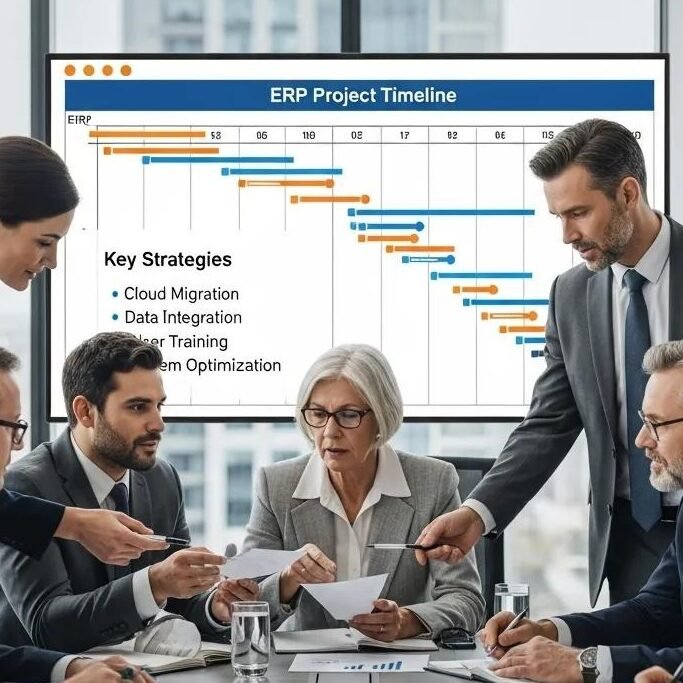
Executive sponsorship provides governance, prioritization, and rapid decision-making; without it, ERP projects face approval bottlenecks, shifting priorities, and constrained funding that delay schedules and reduce scope. Sponsorship furnishes the steering cadence, conflict resolution path, and cross-functional authority required to align IT, finance, operations, and HR around shared objectives. Operationalizing sponsorship means appointing a project sponsor, a steering committee, and clear escalation channels with defined KPIs for governance sessions. The following table clarifies stakeholder roles, responsibilities, and the specific risks when those roles are missing, making sponsorship more tangible for leadership teams.
Clear stakeholder responsibilities reduce ambiguity and accelerate decision-making during critical project moments.
| Stakeholder | Responsibility | Risk if Missing |
|---|---|---|
| CEO / Executive Sponsor | Strategic alignment, priority setting | Project deprioritization, funding risks |
| CIO / IT Leader | Technical architecture and integrations | Integration failures, technical debt |
| Project Sponsor (Business) | Requirements sign-off, change champion | Scope disputes, low user adoption |
| Steering Committee | Governance, risk approval | Slow decisions, unresolved escalations |
How Does Lack of Executive Buy-In Cause ERP Project Delays?
When executives are not visibly committed, cross-functional teams deprioritize the initiative, which causes delayed approvals, insufficient staffing, and missed funding windows that extend timelines. Practically, this means purchase orders or integration approvals sit in inboxes, specialists are pulled away for other fires, and the project loses momentum, raising the likelihood of scope creep and defects. Remediation includes sponsor onboarding sessions, defining a sponsor dashboard with a small set of KPIs, and pre-authorized contingency budgets to maintain velocity during known risk windows. Reinforcing sponsor accountability with scheduled steering meetings and published decision logs mitigates delays and keeps program milestones visible, which also makes resource planning more effective as described next.
What Are Best Practices for Ensuring Adequate Resource Management?
Effective resource management requires a staffed core team, backfill plans for business SMEs, realistic contingency funding, and a decision to augment with external consulting when internal skills gaps threaten schedule. Use resource-loading matrices to visualize capacity, assign a dedicated project manager and product owners, and maintain a risk-adjusted budget with staged releases to reduce one-time capital pressure. External consultants are appropriate when the project requires platform-specific expertise, such as Odoo, Oracle Fusion, Oracle E-Business Suite (EBS), or Oracle NetSuite, or advanced data engineering and reporting skills. Bay Forward provides implementation and consulting services that combine ERP strategy, data engineering, and AI-driven reporting to plug skill gaps and accelerate delivery, enabling internal teams to focus on business validation and adoption. Implementing these resource practices reduces schedule slippage and improves delivery quality.
What Role Do Scope Creep and Over-Customization Play in ERP Failures?
Scope creep and over-customization increase complexity, prolong delivery, and create fragile systems that are expensive to maintain and upgrade. The mechanism is that each customization introduces integration points, testing overhead, and upgrade risk, turning what should be a configurable solution into a bespoke platform. Decision frameworks that favor configuration, prioritize processes by business value, and require governance approval for custom code reduce long-term technical debt. Practical controls include a change control board, impact assessments for requested changes, and phased roadmaps that surface tactical needs for later release. The following subsections tackle timeline/budget sanity and vendor selection, both of which interact heavily with scope decisions.
How Can Unrealistic Timelines and Budget Overruns Derail ERP Projects?
Unrealistic timelines compress design, testing, and training windows, which forces teams to cut corners and accept higher defect rates; similarly, under-budgeted projects drop quality assurance and adequate staffing, creating rework and escalation costs. Mitigations include running a realistic, risk-adjusted timeline with explicit contingency buffers, staging rollouts by module or business unit, and committing to minimum viable scope for the initial release. A budget sanity-check checklist should include line items for data cleanup, change management, contingency, and third-party integrations. Phased rollouts reduce initial risk and make it practical to fund subsequent waves after delivering visible business value, which also informs vendor selection and partnership terms discussed next.
Why Is Proper Vendor Selection and Partnership Crucial?
Selecting the right vendor matters because delivery capability, cultural fit, and knowledge-transfer practices determine whether a vendor becomes a strategic partner or a long-term bottleneck. Evaluate vendors on technical certifications, domain experience in your industry, demonstrated delivery model for the target ERP (Odoo, Oracle Fusion, Oracle E-Business Suite, Oracle NetSuite), and contractual controls like SLAs and knowledge-transfer clauses. Use a vendor due-diligence checklist that includes references, past deployment architectures, and escalation procedures. Red flags include opaque change-control terms, limited documentation, or a single-person dependency; insisting on clear handover plans and training commitments preserves institutional knowledge and reduces operational risk. Effective vendor partnerships accelerate implementation and reduce the chance of costly rework.
How Do Insufficient Testing and Ineffective Communication Undermine ERP Projects?
Insufficient testing leaves defects in production and undermines user confidence, while ineffective communication creates misaligned expectations and stalled cross-functional alignment; together they erode trust and increase the cost of remediation. A robust testing strategy requires unit tests, integration tests, user acceptance testing (UAT), and performance testing with clearly defined exit criteria for each phase. Simultaneously, a communications plan, detailing audiences, cadence, channels, and leadership messaging, keeps stakeholders informed and aligned. The next subsections outline the consequences of poor QA and present communication tactics to improve collaboration and adoption.
What Are the Consequences of Inadequate Testing and Quality Assurance?
When testing is insufficient, defects surface in production workflows, causing operational interruptions, lost revenue, and damaged customer experience; addressing these defects post-go-live costs far more than pre-launch remediation. Essential QA practices include building regression test suites, automated smoke tests for key transactions, and scripted UAT scenarios that reflect real operational use cases. Metrics such as defect escape rate, mean time to resolution, and percentage of automated test coverage help quantify QA effectiveness. By investing in staged testing and automation, organizations reduce production firefighting and build confidence among end users, which links directly to how communication supports adoption and is explored next.
How Does Poor Communication Affect Collaboration and User Engagement?
Poor communication breeds uncertainty about timelines, responsibilities, and expected changes, which drives employees to create workarounds and erodes compliance with new processes. An effective communication plan identifies audiences, uses champions to cascade messages, schedules regular stakeholder updates, and leverages multiple channels: town halls, role-based training, and concise release notes, to reinforce clarity. Measure communications effectiveness with engagement metrics, training completion rates, and sentiment surveys to iterate on messaging. When communication is consistent and transparent, cross-functional collaboration improves and user engagement rises, creating a positive feedback loop that supports successful testing and adoption in subsequent phases.
How Can Businesses Avoid ERP Implementation Mistakes and Ensure Success?
Avoiding ERP implementation mistakes requires a prioritized, repeatable approach that combines governance, data strategy, staged rollout, testing, and change management into an operational playbook. The high-level steps below give leaders a practical starting point to reduce risk: clarify objectives, secure sponsorship, audit data readiness, establish testing and change practices, and select partners who bring domain expertise. The following checklist translates those priorities into actionable steps you can apply immediately, followed by practical success factors and a description of how an integrated consulting approach accelerates results.
Use this prioritized checklist as an operational starting point to triage current project health and define immediate next actions.
- Define clear business objectives and SMART KPIs tied to financial or operational outcomes.
- Secure executive sponsorship and establish a governance cadence with decision SLAs.
- Audit and profile data sources; plan cleansing and reconciliation before cutover.
- Adopt a staged rollout with prioritized scope, rigorous testing, and contingency budgets.
- Build a change management program with role-based training, champions, and adoption KPIs.
This checklist focuses attention on the most impactful early controls and creates a framework for continuous risk management across the program lifecycle. The next subsection summarizes condensed success factors you can operationalize within 30–90 days.
What Are the Key ERP Implementation Success Factors and Risk Management Strategies?
Key success factors include clear governance, robust data strategy, disciplined scope control, comprehensive testing, and active change management; each reduces a category of risk and collectively they create predictable outcomes. Operationalizing these factors starts with a readiness assessment: map current processes, quantify data quality issues, run a sponsor alignment workshop, and develop a test-first rollout plan. Risk management strategies should include a risk register with owners, contingency budgets, and an agreed-upon cutover decision matrix. Quick wins, such as automating critical reports or delivering a single high-value module first, demonstrate momentum and secure ongoing funding for subsequent waves. These elements form the backbone of practical delivery and lead naturally to how an integrated consultancy can help.
How Does Bay Forward’s Integrated ERP, Data, and AI Solutions Prevent Failures?
Bay Forward provides comprehensive ERP consulting and implementation services that combine strategic planning, system selection, data migration, user training, and post-implementation support to reduce the common causes of ERP failure. By integrating ERP expertise across platforms like Odoo, Oracle Fusion, Oracle E-Business Suite, and Oracle NetSuite with data engineering, Microsoft Power BI reporting, and AI-enhanced validation, Bay Forward addresses technical, data, and adoption risks in a coordinated way. Their differentiated approach: AI-enhanced solutions, an integrated ERP+Accounting+Data+AI model, and industry-specific templates, helps shorten migration windows, reduce reconciliation cycles, and improve user adoption. For organizations facing skills gaps, Bayesian-style augmentation from Bay Forward supplies targeted implementation teams that focus on knowledge transfer, governance setup, and measurable KPIs to secure durable business value and lower long-term TCO.
This mapping shows how integrated services convert the risk controls described throughout this article into operational tasks and measurable outcomes that leadership can govern.
- Assessment & Planning: Rapid readiness evaluation and KPI definition for executive alignment.
- Data & Migration: Profiling, automated cleansing, and AI-assisted mapping to shorten reconciliation cycles.
- Delivery & Adoption: Phased rollout, vendor coordination, role-based training, and post-go-live support.
Key Takeaways for ERP Success
To ensure your ERP implementation avoids common pitfalls and delivers lasting value, remember these critical insights:
- Strategic Planning is Paramount: Define clear objectives, KPIs, and a realistic scope from the outset to prevent misalignment and rework.
- Prioritize Change Management: Invest in robust training, communication, and stakeholder engagement to drive user adoption and minimize resistance.
- Master Data Quality: Proactively profile, cleanse, and validate your data to prevent transactional errors and ensure reliable reporting. AI and automation can significantly enhance this process.
- Secure Executive Sponsorship: Strong leadership commitment ensures proper resource allocation, timely decisions, and project prioritization.
- Control Scope and Customization: Implement strict change control and favor configuration over customization to manage costs and technical debt.
- Realistic Timelines & Budgets: Plan with contingency, stage rollouts, and commit to a minimum viable product for initial releases.
- Rigorous Testing is Non-Negotiable: Conduct comprehensive unit, integration, UAT, and performance testing to catch defects before go-live.
- Choose the Right Partner: Select a vendor with proven expertise, cultural fit, and clear knowledge transfer plans.
- Effective Communication: Maintain transparent and consistent communication across all stakeholders to align expectations and foster collaboration.
- Integrated Approach: Combine strategic planning, data engineering, and AI-driven solutions for a holistic strategy that addresses all facets of ERP success.
Get Expert ERP Consulting Today
Understanding the common causes of ERP implementation failures empowers organizations to mitigate risks and enhance project success. By prioritizing clear objectives, effective change management, and robust data strategies, businesses can significantly improve their chances of achieving desired outcomes. Implementing these best practices not only streamlines processes but also fosters user adoption and operational efficiency. Start your journey towards successful ERP implementation by exploring our expert consulting services today.